CSQ CERTIFICATION
The CSQ Certification Program and applicable standards were built around ISO/IEC 17067

SQF, or Safe Quality Food, is a comprehensive assessment of a food manufacturing or processing facility's adherence to food safety and quality standards.

CanadaGAP is a food safety program for the fresh produce industry, based on HACCP principles. It covers good agricultural practices (GAP) for on-farm activities and good manufacturing practices (GMP) for packing and storage.

FSSC 22000 integrates ISO 22000 for comprehensive food safety management.

This certification covers multiple sectors such as food manufacturing, packaging, storage, distribution, and consumer products.
IFS Certification refers to a globally recognized certification system focused primarily on ensuring the safety, quality, and compliance of products and processes.
PrimusGFS certification is a food safety standard specifically designed for the fresh produce industry. It covers various aspects of food safety, including good agricultural practices (GAP), good manufacturing practices (GMP), and food safety management systems.
In person at our training center

Virtual, led by an Kiwa ASI expert
Learn anytime, at your pace
Live & on-demand · no cost
Phone hotline 1 (800) 477-0778 · US.Info@kiwa-asi.com
Kiwa ASI
Nearly a century of food safety expertise, headquartered in St. Louis.
Audits & Inspections
Independent second- and third-party audits for facilities at every stage.
cGMP Audits
Sector-specific Good Manufacturing Practice audits.
GFSI Certification
GFSI-benchmarked programs accepted by major retailers worldwide.
Cannabis Certification
Prove product safety in cultivation, extraction and manufacturing.
Cosmetics Certification
GMP for the cosmetics industry, including MoCRA readiness.
Dietary Supplement Certification
Go beyond basic GMPs with GFSI-benchmarked quality management.
CSR & Sustainability
Certifications for sourcing, allergens and environmental claims.
Food & Beverage
Audits and certification from primary production to complex manufacturing.
Cannabis
CSQ, GMP and state-specific regulatory audits.
Certification
State programs
In every tier, CSQ certification is an independent way to prove your program.
Regulatory QMS
Not sure which program your license requires? Our team maps state rules to the right audit.
Talk to a cannabis specialist →Cosmetics
GMP verification for beauty and personal-care manufacturers.
Dietary Supplements
FDA 21 CFR 111 compliance and GFSI-level quality.
Live Trainings in St. Louis
In-person classes at our St. Louis headquarters.
Live Instructor-Led Training
Virtual classes led by Kiwa ASI instructors.
SQF Edition 10
FDA & Regulatory
Hazards & Controls
Online Self-Paced Training
Learn on your schedule with e-learning courses.
Free Webinars
A 6-part 2026 series on SQF Edition 10, supplier management and compliance.
Resources
Articles, answers and media from the Kiwa ASI team.
Forms
Order certification banners or submit feedback.
Show Me Food Safety Scholarship
Supporting the next generation of food safety professionals.
DQMP is McDonald's food safety and quality standard for the warehouse and distribution operations that deliver to its restaurants. It covers storage and transport, not manufacturing. A full DQMP audit is typically two days and unannounced, carried out every year by an audit firm McDonald's has approved. Kiwa ASI delivers DQMP audits for U.S. distribution centers, as a full audit or as an add-on to your SQF or BRCGS Storage and Distribution audit.
Last updated October 8, 2026
Tell us about your distribution center, temperature zones and delivery fleet. We'll recommend the right DQMP format for your site and send a quote.
A McDonald's DQMP audit is an independent check that a distribution center meets McDonald's Distributor Quality Management Process, the company's food safety and quality standard for the warehouse and distribution operations that deliver to its restaurants. It covers how McDonald's products are received, stored and transported, and Kiwa gives storage facilities and transport trucks as examples.
McDonald's runs third-party audits at three points in its supply chain: restaurants; supplier locations, where the Supplier Quality Management System (SQMS) applies; and distribution centers, where DQMP applies. McDonald's ties both SQMS and DQMP to suppliers "establishing, implementing, documenting and maintaining food safety and quality management systems" (McDonald's).
McDonald's own reports call it the Distributor Quality Management Process; its November 2024 food safety fact sheet uses "Distribution Quality Management Program." Both mean the same standard.
McDonald's reports DQMP results as whether a distribution center was found "operating consistently with" its standard. DQMP isn't an accredited certification like SQF or BRCGS, and McDonald's doesn't publish the DQMP checklist, a pass mark or temperature limits. Distributors get the current requirements from McDonald's.
Applies to the warehouse and distribution operations that deliver to McDonald's restaurants: receiving, storage and transport.
A full DQMP audit is typically a comprehensive two-day, unannounced audit of the distribution center.
McDonald's says its distribution partners are audited annually by third-party auditors.
Only audit firms McDonald's has approved perform DQMP audits; firms announce their own approval.
SQMS is McDonald's standard for the companies that make its food; DQMP is its standard for the companies that store and deliver it. Kiwa describes SQMS as requirements for all McDonald's suppliers of processed food, and DQMP as the corresponding requirements for distribution centers, such as storage facilities and transport trucks. If you make food or packaging for McDonald's, you're in SQMS or GQSR territory, not DQMP.
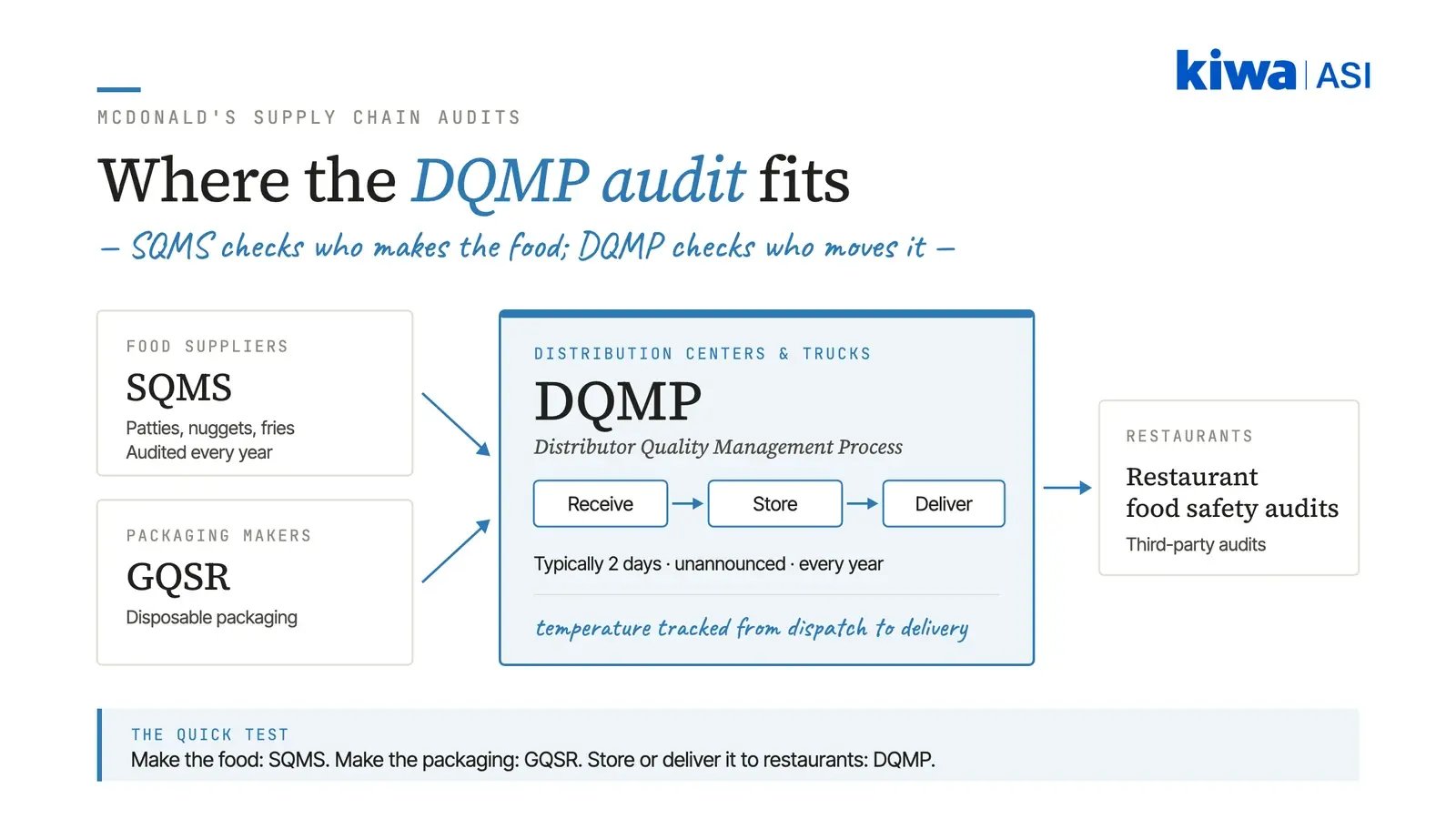
| Program | Who it applies to | What it covers |
|---|---|---|
| SQMS (Supplier Quality Management System) | Suppliers of processed food to McDonald's, such as burgers, patties, nuggets, fries, buns, cheese and sauces | Food safety and quality where the food is made; audited every year. SQFI offers McDonald's addenda for produce, food manufacturing and food packaging suppliers |
| DQMP (Distributor Quality Management Process) | Warehouse and distribution operations that deliver to McDonald's restaurants | Receiving, storage and transport, including delivery trucks; audited every year. A full audit is typically two days and unannounced |
| GQSR (Global Quality & Safety Requirements for Disposable Packaging) | Suppliers of disposable packaging | McDonald's quality and safety requirements for packaging, not for distribution centers |
Sources: Kiwa, McDonald's, SQFI and Arcos Dorados Form 20-F. For other retailer and foodservice programs, see supplier audits and retailer audit programs.
A DQMP audit is for the warehouse and distribution operations that deliver to McDonald's restaurants, including their storage facilities and delivery trucks. If you're not sure your site is in scope, ask your McDonald's supply chain or quality contact before you book anything.
Sites that receive, store and ship McDonald's products to restaurants are the core of DQMP.
Frozen, chilled and dry storage that's part of the restaurant delivery operation, including temperature-controlled zones.
The trucks that carry product to restaurants. McDonald's requires continuous temperature monitoring from dispatch to delivery and clean delivery trucks.
Food and packaging manufacturers fall under SQMS or GQSR instead. For a cold store or third-party logistics (3PL) provider that holds product upstream for a supplier, scope isn't published, so confirm it with McDonald's.
A full DQMP audit is typically two days and unannounced. DQMP can also be added to a certification audit recognized by the Global Food Safety Initiative (GFSI). Kiwa ASI delivers McDonald's DQMP audits for U.S. distribution centers as a full DQMP audit or as an add-on to your SQF or BRCGS Storage and Distribution audit, so your GFSI certification audit and McDonald's DQMP can be covered together. McDonald's doesn't publish which format it expects for each site, so confirm it with your McDonald's contact.
SQFI publishes three McDonald's addenda, for produce, food manufacturing and food packaging suppliers (SQFI). None covers storage and distribution, so an SQF Storage and Distribution audit doesn't include DQMP on its own. When Kiwa ASI adds DQMP to your SQF audit, it's audited as McDonald's own standard alongside SQF.
A comprehensive audit of the distribution center against McDonald's DQMP standard, typically two days on site and unannounced.
Kiwa ASI can add the DQMP audit to your SQF or BRCGS Storage and Distribution audit, so your GFSI certification audit and McDonald's DQMP are covered together.
A separate certification your other customers may ask for, such as SQF or BRCGS Storage and Distribution. It doesn't replace DQMP.
| Program | GFSI recognition |
|---|---|
| SQF Storage and Distribution (Food Sector Category 26) | Edition 9, scope G |
| BRCGS Storage and Distribution (Issue 4) | Scope G |
| IFS Logistics | Scope G (GFSI lists version 2.3; version 3 is in GFSI benchmarking) |
| FSSC 22000 (category G, transport and storage) | Version 6, scope G |
See who issues each one under DQMP and distribution audits at Kiwa ASI. GFSI recognition per GFSI, SQFI, BRCGS and IFS. SQF Edition 10 audits start no earlier than January 2, 2027 (SQFI); see what changes in SQF Edition 10 for storage and distribution.
McDonald's DQMP requirements cover how a distribution center receives, stores and transports McDonald's products. Public sources describe receiving checks, storage, continuous temperature monitoring from dispatch to delivery, clean delivery trucks, traceability, and a documented food safety and quality management system. McDonald's gives distribution partners the DQMP standard and supporting material directly; it isn't public. The areas below come from McDonald's, Kiwa and a McDonald's franchisee's SEC filing.
| Area | What's publicly described |
|---|---|
| Receiving (acceptance) | Acceptance of McDonald's product and a quality inspection program on receiving and unloading (Arcos Dorados filing). |
| Storage | How McDonald's products are held in the distribution center, including storage facilities (Kiwa). |
| Cold chain and temperature monitoring | Continuous temperature monitoring from dispatch to delivery (McDonald's fact sheet, November 2024). |
| Delivery trucks | Cleanliness of delivery trucks and continuous temperature monitoring systems in the trucks (McDonald's). |
| Food safety and quality management system | Establishing, implementing, documenting and maintaining food safety and quality management systems (McDonald's). |
| Traceability | Product traceability from ingredient to restaurant (McDonald's). Separately from DQMP, McDonald's markets run annual mock product withdrawal exercises that include distributors. |
| Foreign material, shelf life, security and crisis management | Arcos Dorados, which runs McDonald's restaurants in Latin America, lists foreign material control, shelf life, facility security, crisis management and stock recovery among DQMP topics. |
McDonald's reports DQMP outcomes as the share of distribution centers found operating consistently with the standard. These are global figures from its annual reports.
| Year | Distribution centers audited | Result McDonald's reported |
|---|---|---|
| 2024 | 200+ | All found operating consistently with the DQMP audit standard |
| 2023 | 250+ | Over 98% found operating consistently with the DQMP audit standard |
| 2022 | 239 | 97% fully met the standard |
Sources: Purpose & Impact Progress Report 2024–2025, 2023–2024 report and 2022–2023 report. The 2022 and 2023 figures show that some distribution centers fall short. McDonald's doesn't publish a DQMP pass mark.
McDonald's holds its logistics and distribution providers to requirements that include continuous temperature monitoring from dispatch to delivery and clean delivery trucks (McDonald's). The detailed DQMP requirements are in the standard McDonald's gives its distributors and aren't public. U.S. food law adds a baseline that applies whether or not you serve McDonald's.
The main federal rule is FDA's Sanitary Transportation rule. It covers shippers, loaders, receivers and carriers moving food by motor vehicle or rail, even within one state. Businesses averaging under $500,000 a year in revenue, adjusted for inflation ($686,476 for 2023–2025), aren't covered, and neither is food fully enclosed in a container unless it needs temperature control for safety (21 CFR 1.904).
| Topic and rule | What it requires |
|---|---|
| Vehicles: 21 CFR 1.906(c) | Vehicles and equipment used for food that needs temperature control for safety must be designed, maintained and equipped to provide adequate temperature control. |
| Shipper's temperature specs: 21 CFR 1.908(b)(2) | In most cases the shipper must give the carrier the operating temperature in writing, including pre-cooling if necessary. |
| Pre-loading check: 21 CFR 1.908(c)(2) | Before loading temperature-controlled food, the loader must verify each refrigerated compartment is ready, including pre-cooled if necessary. |
| Receiving check: 21 CFR 1.908(d) | On receipt, the receiver must assess whether the food was subjected to significant temperature abuse, for example by checking the food's temperature or the vehicle's ambient temperature. |
| Carrier duties: 21 CFR 1.908(e) | Where a written agreement makes the carrier responsible, it pre-cools as specified and, on request, shows it kept the specified temperature. |
| Single legal entity: 21 CFR 1.908(a)(5) | Shippers, loaders, receivers and carriers under one legal entity, such as a distributor running its own fleet, can follow common, integrated written procedures instead of the shipper, receiver and carrier duties in 1.908(b), (d) and (e). Loader checks in 1.908(c) still apply. |
| Temperature failure: 21 CFR 1.908(a)(6) | After a possible material failure of temperature control, the food can't be sold or distributed unless a qualified individual determines it's safe. |
| Carrier training: 21 CFR 1.910 | Carriers train staff in sanitary transportation practices on hiring and as needed when a written contract makes them responsible for sanitary conditions. |
| Warehousing: 21 CFR 117.93 | Storage and transport must protect food against allergen cross-contact, contamination and deterioration of the food and container. |
| Storage-only sites: 21 CFR 117.7 and 117.206 | A facility solely storing unexposed packaged food that holds refrigerated TCS food must set temperature controls, monitor them, take corrective action, verify (calibrate devices, and review monitoring and corrective-action records within 7 working days unless a PCQI justifies a longer time in writing) and keep records. |
| Traceability (FSMA 204): 21 CFR 1.1340 and 1.1345 | For foods on FDA's Food Traceability List, keep receiving and shipping records linked to each traceability lot. FDA proposed moving the compliance date to July 20, 2028, and Congress directed FDA not to enforce before then. |
| Meat and poultry (FSIS): 9 CFR 320.5 and 381.179 | Public warehousemen and wholesalers of meat or poultry products must register with USDA FSIS, unless they operate only at an official establishment. |
| Restaurant receiving: FDA Food Code 3-202.11 | Restaurants under state codes based on the Food Code must receive refrigerated TCS food at 41°F (5°C) or below, unless a law governing the food's distribution, such as for milk or shellfish, sets another temperature. Raw eggs must be received in refrigerated equipment that keeps the air at 45°F (7°C) or less. The Food Code doesn't govern distribution centers, but it's the standard your deliveries meet at the restaurant door. |
Retention periods differ by rule, so set your record policy to the longest one that applies.
| Records | Keep for | Rule |
|---|---|---|
| Sanitary transportation agreements, procedures and carrier training | 12 months after the agreement or procedure ends, or after a trained person stops the duties | 21 CFR 1.912 |
| Temperature monitoring, corrective action and verification records | At least two years after they're created | 21 CFR 117.315 |
| Food traceability (FSMA 204) records | Two years; provide to FDA within 24 hours of a request | 21 CFR 1.1455 |
Only third-party audit firms McDonald's has approved can perform DQMP audits, so a certification body needs McDonald's approval for DQMP, not just accreditation for a GFSI-recognized scheme. McDonald's refers to "our approved third-party auditing firms" in its reporting (McDonald's SASB index) but doesn't publish a list of them; firms announce their own approval. The Kiwa group, which Kiwa ASI belongs to, announced in July 2023 that it is approved to deliver McDonald's SQMS and DQMP audits, an approval that came with its acquisition of Valiguard AB (Kiwa). Kiwa ASI delivers McDonald's DQMP audits for U.S. distribution centers.
Your McDonald's supply chain or quality contact can confirm the audit you need and the approved firms you may book.
Ask the audit firm for its McDonald's approval for DQMP, not just for SQMS or a GFSI scheme, and who will audit your site.
DQMP isn't a certification scheme like SQF or BRCGS, and results are reported to McDonald's. Be wary of anyone offering DQMP paperwork without an audit by a McDonald's-approved firm, or promising you'll pass.
To schedule a McDonald's DQMP audit, confirm the requirement and due date with your McDonald's contact, then send Kiwa ASI your site details so we can recommend the format and quote it. Because a full DQMP audit is typically unannounced, you book the audit but won't get a fixed date.
Check with your McDonald's contact that your site needs a DQMP audit, which format is expected and when it's due.
Address, building size, temperature zones (frozen, chilled, dry), fleet size, shifts and any current certifications, such as SQF or BRCGS Storage and Distribution.
We recommend a full DQMP audit or a DQMP add-on to your SQF or BRCGS Storage and Distribution audit, based on what McDonald's expects for your site, and tell you who will audit it.
We quote the audit days, travel and any other fees separately.
Work through the DQMP audit checklist below so you're ready whenever the auditor arrives.
The auditor reviews receiving, storage, transport, records and your food safety and quality system, and the results are reported to McDonald's.
Correct non-conformities and send evidence. We explain how findings are closed and whether a follow-up visit is needed.
There's no published price for a DQMP audit. The cost depends mostly on audit days, which for a full DQMP audit are typically two, plus auditor travel and any follow-up work. Ask each approved firm to quote the same scope.
A full DQMP audit is typically two days on site. As an add-on to your SQF or BRCGS audit, we quote the DQMP time on top of that audit.
Auditor travel time and expenses. Ask whether they're billed at cost or as a flat fee.
Each distribution center is audited. Multi-site distributors can ask about coordinated scheduling.
Reviewing corrective action evidence and any follow-up visit, if one is requested.
Staff time, internal audits, temperature monitoring equipment and any fixes.
For Kiwa pricing on your site, request a quote.
To prepare for a DQMP audit, work from the current DQMP standard McDonald's gives you, then check the cold chain, trucks, traceability and records against it and against U.S. law. These steps cover the areas public sources describe.
Use the version and supporting material McDonald's gives you, not an old copy or a generic checklist.
List every frozen, chilled and dry zone, its set point and how it's monitored, alarmed and recorded.
Show continuous temperature data for delivery routes, who reviews it and what happens when a reading is out of range.
Confirm dock checks on product temperature and condition, plus what you do with product that may have been temperature-abused.
Check that each truck and trailer is clean, maintained and pre-cooled when needed, and keep cleaning and pre-cooling records.
Run a mock withdrawal: trace a lot from receipt to restaurant deliveries within your target time, and keep FSMA 204 records where they apply.
Procedures, training records, pest control, sanitation, maintenance, product rotation and shelf life.
Audit yourself against the DQMP standard, fix what you find and record the corrective actions.
Records accessible and a trained person available on each shift, since the audit is typically unannounced.
Related training from ASI Training and Consulting, LLC: principles of internal auditing, BRCGS Storage and Distribution, food defense and FSMA 204. Training is optional and has no effect on audit outcomes.
Kiwa ASI (ASI Food Safety, LLC), based in St. Ann, Missouri, audits and certifies food sites across the U.S. and is part of the Kiwa group. The table shows which body delivers or issues each audit a distribution center is likely to need.
| Audit or program | Who delivers or issues it | Notes |
|---|---|---|
| McDonald's DQMP audit | Kiwa ASI, under the Kiwa group's McDonald's approval (announced July 2023). | McDonald's own standard, not a certification scheme. Full audit or add-on to SQF or BRCGS Storage and Distribution. |
| SQF Storage and Distribution (FSC 26) | ASI Food Safety, LLC (Kiwa ASI): SQFI-licensed and accredited by ANAB to ISO/IEC 17065 (ID 1222) for SQF Storage and Distribution Edition 9. | GFSI-recognized (Edition 9); Edition 10 audits start no earlier than January 2, 2027. |
| BRCGS Storage and Distribution (Issue 4) | Kiwa Ltd (trading as Kiwa Agri Food), a UKAS-accredited, BRCGS-approved certification body. Kiwa ASI is a listed U.S. office. | GFSI-recognized. |
| IFS Logistics | Kiwa España SLU, an IFS-approved certification body accredited by ENAC. Kiwa ASI is its U.S. office. | GFSI-recognized per IFS; GFSI's list names version 2.3, and version 3 is in GFSI benchmarking. |
| FSSC 22000 (category G, transport and storage) | Kiwa VERIN B.V., a Kiwa group certification body licensed by Foundation FSSC. | Version 6 is GFSI-recognized for category G. |
| cGDP audit | Kiwa ASI, to its own current good distribution practices audit standard. | Not GFSI-benchmarked or accredited. |
Not offered: laboratory testing. Kiwa ASI training and consulting is provided by ASI Training and Consulting, LLC, which operates separately from the certification body and has no effect on audit outcomes. Read more about third-party food safety audits.
Short definitions of the terms you'll meet in McDonald's audit requests and U.S. distribution rules.
Distributor Quality Management Process: McDonald's food safety and quality standard for warehouse and distribution operations that deliver to its restaurants, audited every year by McDonald's-approved audit firms. Also called the Distribution Quality Management Program. The supplier counterpart is SQMS.
Supplier Quality Management System: McDonald's food safety and quality standard for suppliers of food products, audited every year.
Global Quality & Safety Requirements: McDonald's requirements for manufacturers of disposable packaging.
An audit company McDonald's has approved to perform its supplier audits, such as SQMS and DQMP.
An audit without advance notice of the date. A full DQMP audit is typically unannounced.
Extra requirements audited alongside a certification audit, such as SQFI's McDonald's addenda for food suppliers.
The Global Food Safety Initiative's scope for storage and distribution services, covered by SQF, BRCGS, IFS Logistics and FSSC 22000.
Food that needs time/temperature control to prevent the growth of, or toxin production by, pathogens. Several U.S. temperature rules on this page apply only to TCS food.
FDA's rule (21 CFR Part 1, Subpart O) on how shippers, loaders, receivers and carriers keep food safe in transport.
Under FSMA 204, a batch of a Food Traceability List food identified by a lot code, which receiving and shipping records must link to.
A McDonald's DQMP audit checks that a distribution center meets McDonald's Distributor Quality Management Process, the company's food safety and quality standard for warehouse and distribution operations that deliver to its restaurants. It covers how product is received, stored and transported. A full audit is typically two days, unannounced and done every year by an approved audit firm.
DQMP stands for Distributor Quality Management Process, the name McDonald's uses in its Purpose & Impact reports. McDonald's November 2024 food safety fact sheet calls it the Distribution Quality Management Program. Both refer to the same McDonald's standard for distribution centers.
Warehouse and distribution operations that deliver to McDonald's restaurants need a DQMP audit, including their storage facilities and delivery trucks. Food and packaging manufacturers fall under SQMS or GQSR instead. If you store product upstream for a supplier and aren't sure, ask your McDonald's contact before booking.
SQMS (Supplier Quality Management System) is McDonald's standard for companies that make its food, such as patty, nugget and fry suppliers. DQMP is its standard for the companies that store and deliver that food to restaurants. Both are audited every year by approved audit firms, but they cover different sites and requirements.
McDonald's says its distribution partners follow its DQMP (Distributor Quality Management Process) standards and are audited every year by third-party auditors. Its public requirements include continuous temperature monitoring from dispatch to delivery and clean delivery trucks. In the U.S., FDA's Sanitary Transportation rule and the cGMP warehousing and distribution requirement (21 CFR 117.93) also apply in most cases, and other customers may ask for GFSI storage and distribution certification.
Only third-party audit firms McDonald's has approved can perform DQMP audits, so a certification body needs McDonald's approval for DQMP, not just accreditation for a GFSI-recognized scheme. McDonald's doesn't publish a list; firms announce their own approval. The Kiwa group announced in July 2023 that it is approved to deliver McDonald's SQMS and DQMP audits, and Kiwa ASI delivers DQMP audits for U.S. distribution centers.
To meet McDonald's DQMP, confirm with McDonald's that your distribution center is in scope, prepare against the current DQMP standard McDonald's gives you and complete the annual audit with a McDonald's-approved audit firm. DQMP isn't a certification scheme like SQF or BRCGS: McDonald's reports results as whether a site was found operating consistently with its standard.
A full DQMP audit is typically unannounced, so you won't get a fixed date. Keep records available and trained people on every shift. If you add DQMP to your SQF or BRCGS audit, ask how that combined audit is scheduled.
A full DQMP audit typically takes two days on site. As an add-on to an SQF or BRCGS Storage and Distribution audit, the DQMP time is added to that audit, and Kiwa ASI quotes the days for your site. Confirm with your McDonald's contact which format they expect.
DQMP audits are done every year. McDonald's says its distribution partners are audited annually by third-party auditors to check compliance with its requirements.
Yes. Kiwa ASI can run the DQMP audit as an add-on to your SQF Storage and Distribution audit, or to a BRCGS Storage and Distribution audit. It isn't an SQF addendum: SQFI's three McDonald's addenda cover produce, food manufacturing and packaging suppliers, so DQMP stays McDonald's own audit. Confirm with your McDonald's contact that the add-on format suits your site.
A GFSI + DQMP addendum audit is a DQMP audit run alongside a GFSI-recognized certification audit at the same site, offered as an alternative to the full two-day DQMP audit. Kiwa ASI offers it with SQF and BRCGS Storage and Distribution audits. McDonald's doesn't publish which format it expects for each site, so confirm with your McDonald's contact first.
McDonald's public documents name DQMP as the standard for distribution centers and don't publish a separate GFSI certification requirement for them. Other customers may ask for GFSI-recognized storage and distribution certification, such as SQF or BRCGS Storage and Distribution, so check each customer's requirements.
McDonald's requires continuous temperature monitoring from dispatch to delivery and clean delivery trucks; the detailed DQMP requirements come from McDonald's and aren't public. U.S. law adds a baseline: FDA's Sanitary Transportation rule (21 CFR 1.908) and, for facilities solely storing unexposed packaged food that hold refrigerated food needing temperature control for safety, 21 CFR 117.206.
Public sources describe a DQMP audit covering receiving, storage, cold chain and continuous temperature monitoring, delivery truck cleanliness, traceability, and a documented food safety and quality management system. A franchisee's filing adds foreign material control, shelf life, security and crisis management. The full checklist comes from McDonald's and isn't public.
There's no published price for a DQMP audit. Cost depends mostly on audit days, typically two for a full audit, plus auditor travel, the number of sites and any follow-up work. Ask each approved audit firm to quote the same scope, with audit days, travel and fees shown separately.
Findings must be corrected; ask your audit firm how closure is verified. Not every site meets the standard: McDonald's reported that over 98% of the 250+ distribution centers audited in 2023 were operating consistently with DQMP. One franchisee's SEC filing says its own distributor must comply with DQMP to keep its McDonald's-approved supplier status.
In most cases, yes. The rule covers shippers, loaders, receivers and carriers moving food by motor vehicle or rail, including temperature-controlled food in closed containers. Businesses averaging under $500,000 a year in revenue, adjusted for inflation, aren't covered, and facilities regulated exclusively by USDA throughout the entire facility are excluded.
Yes, if you receive or ship foods on FDA's Food Traceability List, you must keep traceability records linked to each traceability lot. FDA proposed moving the compliance date to July 20, 2028, and Congress directed FDA not to enforce the rule before then. Records are kept for two years.
First confirm with your McDonald's contact that your site needs a DQMP audit and when it's due. Then request a quote with your site details: location, size, temperature zones, fleet and current certifications. We'll recommend a full DQMP audit or an add-on to your SQF or BRCGS Storage and Distribution audit and send a quote. Call 1 (800) 477-0778 or email US.Info@kiwa-asi.com.
Facts on this page were checked against these sources on October 8, 2026. McDonald's doesn't publish its DQMP standard, so program details come from McDonald's reports, Kiwa and a McDonald's franchisee's SEC filing. Regulations are paraphrased; read the original before relying on them.
McDonald's is a trademark of its owner, used here only to identify its programs. This page is Kiwa ASI's independent guide and isn't published, sponsored or endorsed by McDonald's.
Tell us about your distribution center and what McDonald's has asked for. We'll recommend a full DQMP audit or an add-on to your SQF or BRCGS Storage and Distribution audit and send a quote.
ASI Food Safety, LLC (Kiwa ASI) is accredited by ANAB to ISO/IEC 17065 (ID 1222) for SQF Edition 9 codes, including Storage and Distribution. BRCGS, IFS and FSSC 22000 certificates are issued by Kiwa group certification bodies. Kiwa ASI training and consulting is provided by ASI Training and Consulting, LLC, which operates separately from the certification body and has no effect on audit outcomes.