CSQ CERTIFICATION
The CSQ Certification Program and applicable standards were built around ISO/IEC 17067

SQF, or Safe Quality Food, is a comprehensive assessment of a food manufacturing or processing facility's adherence to food safety and quality standards.

CanadaGAP is a food safety program for the fresh produce industry, based on HACCP principles. It covers good agricultural practices (GAP) for on-farm activities and good manufacturing practices (GMP) for packing and storage.

FSSC 22000 integrates ISO 22000 for comprehensive food safety management.

This certification covers multiple sectors such as food manufacturing, packaging, storage, distribution, and consumer products.
IFS Certification refers to a globally recognized certification system focused primarily on ensuring the safety, quality, and compliance of products and processes.
PrimusGFS certification is a food safety standard specifically designed for the fresh produce industry. It covers various aspects of food safety, including good agricultural practices (GAP), good manufacturing practices (GMP), and food safety management systems.
In person at our training center

Virtual, led by an Kiwa ASI expert
Learn anytime, at your pace
Live & on-demand · no cost
Phone hotline 1 (800) 477-0778 · US.Info@kiwa-asi.com
Kiwa ASI
Nearly a century of food safety expertise, headquartered in St. Louis.
Audits & Inspections
Independent second- and third-party audits for facilities at every stage.
cGMP Audits
Sector-specific Good Manufacturing Practice audits.
GFSI Certification
GFSI-benchmarked programs accepted by major retailers worldwide.
Cannabis Certification
Prove product safety in cultivation, extraction and manufacturing.
Cosmetics Certification
GMP for the cosmetics industry, including MoCRA readiness.
Dietary Supplement Certification
Go beyond basic GMPs with GFSI-benchmarked quality management.
CSR & Sustainability
Certifications for sourcing, allergens and environmental claims.
Food & Beverage
Audits and certification from primary production to complex manufacturing.
Cannabis
CSQ, GMP and state-specific regulatory audits.
Certification
State programs
In every tier, CSQ certification is an independent way to prove your program.
Regulatory QMS
Not sure which program your license requires? Our team maps state rules to the right audit.
Talk to a cannabis specialist →Cosmetics
GMP verification for beauty and personal-care manufacturers.
Dietary Supplements
FDA 21 CFR 111 compliance and GFSI-level quality.
Live Trainings in St. Louis
In-person classes at our St. Louis headquarters.
Live Instructor-Led Training
Virtual classes led by Kiwa ASI instructors.
SQF Edition 10
FDA & Regulatory
Hazards & Controls
Online Self-Paced Training
Learn on your schedule with e-learning courses.
Free Webinars
A 6-part 2026 series on SQF Edition 10, supplier management and compliance.
Resources
Articles, answers and media from the Kiwa ASI team.
Forms
Order certification banners or submit feedback.
Show Me Food Safety Scholarship
Supporting the next generation of food safety professionals.
A third-party food safety audit is an assessment of a food site against a published standard by an organization independent of both the site and its customers, usually an accredited certification body. Many are certification audits to GFSI-recognized programs such as SQF, BRCGS, FSSC 22000 and IFS. This guide explains how these audits work and how to choose a food safety audit company and check it in the public directories.
Last updated October 7, 2026
Tell us your products, site and the standard your customers ask for. We'll explain your options and, if you'd like one, send a quote.
A food safety audit is a systematic, independent and documented check of whether a food business meets written food safety criteria, such as a certification standard, a customer's requirements or its own procedures. A third-party food safety audit is one done by an organization with no stake in the customer-supplier relationship: ASQ describes a third-party audit as one performed by an organization independent of the customer and the supplier and free of conflicts of interest.
The most familiar kind is the certification audit. A certification body accredited for a scheme such as SQF, BRCGS, FSSC 22000, IFS, PrimusGFS or CanadaGAP sends a registered auditor to review your records, interview staff and watch production. If your site meets the standard, the certification body issues a certificate that buyers can accept instead of each sending their own auditor. Other third-party audits check good manufacturing practices or a buyer's own requirements, and may not end in a certificate.
This guide covers audits of food manufacturers, packers, warehouses and other suppliers. Restaurant and grocery store inspections, often what people mean by a "food audit" in retail, are different: state and local health departments carry them out under rules modeled on the FDA Food Code.
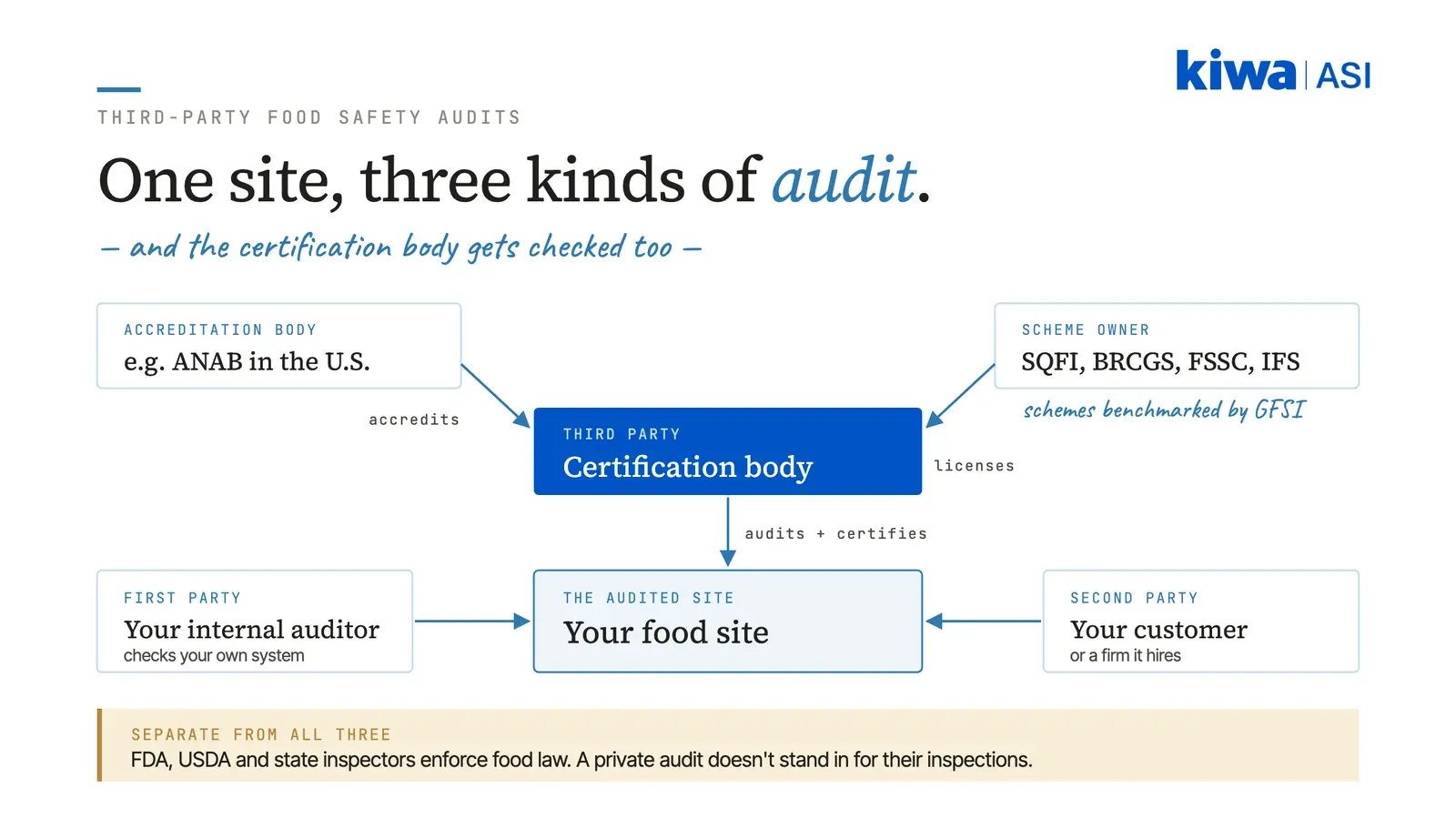
FDA, USDA and state and local agencies inspect food businesses to enforce the law, and USDA FSIS inspectors carry out inspection activities in meat and poultry plants daily. A private audit doesn't stand in for that. Even audits under FDA's own accredited third-party certification program are, by rule, not FDA inspections (21 CFR 1.600).
The auditor works for neither the supplier nor the buyer. For supplier audits under the Food Safety Modernization Act (FSMA), FDA bars financial conflicts of interest that influence the result, and payment tied to the result.
A certification scheme such as the SQF Food Safety Code or the BRCGS Global Standard for Food Safety, a GMP standard, or a buyer's requirements.
Findings come from records, interviews and what the auditor sees on the floor, and each gap is graded as a non-conformity.
Certification audits recur every year, and GFSI-recognized schemes must give processing sites at least one unannounced audit every three years.
First-, second- and third-party food safety audits differ in who does the audit and who relies on the result. A first-party audit is your own internal check. A second-party audit is done by a customer, or a firm working on the customer's behalf, against that customer's requirements. A third-party audit is done by an organization independent of both, usually against a published standard, and often ends in certification. These are the definitions ASQ uses; its general definition of an audit comes from ISO 19011.
| Type | Who does it | Who it's for | Criteria | Typical result |
|---|---|---|---|---|
| First-party (internal) audit | Your own staff, independent of the area they audit | Your management | Your procedures and the standard you follow | Internal findings and corrective actions |
| Second-party (supplier) audit | Your customer, or an audit firm working for the customer | The customer | The customer's requirements, such as a retailer audit program or GMP checklist | Supplier approval, a score or a list of fixes; no certificate |
| Third-party (certification) audit | An independent certification body accredited for the scheme | You and any buyer that accepts the scheme | A published standard, such as SQF, BRCGS, FSSC 22000 or IFS | A certificate and an audit report; most schemes list certified sites publicly |
| Regulatory inspection | FDA, USDA FSIS or a state or local agency | The public | Federal, state and local food law | Inspection findings and, if needed, enforcement |
Buyers often use more than one. A common pattern is GFSI-recognized certification as the baseline, with the buyer's own second-party audit or checklist on top. Read more about second-party supplier audits and retailer audit programs.
The main types of food safety audits in the U.S. are certification audits to GFSI-recognized schemes, GMP audits, FSMA supplier verification audits, customer (second-party) audits, USDA GAP and GHP audits, and pre-assessments. They differ in the standard used, who accepts the result and whether you get a certificate.
Audits to programs benchmarked by the Global Food Safety Initiative, including SQF, BRCGS, FSSC 22000, IFS, PrimusGFS and CanadaGAP. An accredited certification body issues the certificate, and many retailers and foodservice buyers accept it.
Good manufacturing practice audits check sanitation, facilities, pest control, hygiene and records, often against criteria built on FDA's current good manufacturing practice rules in 21 CFR 117, Subpart B. Many are an audit company's own standard and aren't GFSI-recognized or accredited.
When a supplier controls a hazard with a reasonable probability of causing serious illness or death, FDA's preventive controls rule makes an onsite audit by a qualified auditor the default check, before first use and at least once a year. Importers have a matching rule under FSVP.
A buyer's own audit, such as a retailer's supplier program or a brand's GMP checklist, done by the buyer or an audit firm it appoints. Even when an outside firm does the work, it's a second-party audit because it serves the buyer.
Voluntary audits run by USDA's Agricultural Marketing Service that check fruits and vegetables are produced, packed, handled and stored to minimize microbial food safety risks.
A practice run against the standard before the certification audit. It shows where you stand but doesn't lead to a certificate. Designing the fixes is consulting, so do that with your own team or a consultant who won't be your auditor.
Food manufacturers, co-packers, ingredient suppliers, produce growers, packaging makers, warehouses and importers usually need a third-party food safety audit because their customers require one, not because the law does. Retailers, foodservice companies and brand owners write audits into their supplier requirements. You're likely to need one if you're in one of these groups.
Large buyers often require GFSI-recognized certification. Walmart, for example, requires it, or by exception an approved alternative audit, from private brand food suppliers. See our Walmart supplier guide.
Brand owners need independent evidence that the plant making their product meets a recognized standard.
Customers' supplier approval programs often ask for certification, and under FSMA an annual onsite audit is your customer's default check when you control a hazard with a reasonable probability of causing serious illness or death.
Fresh produce buyers commonly ask for a GFSI-recognized produce program such as PrimusGFS, CanadaGAP or SQF, or a USDA GAP audit.
Food-contact packaging makers can certify to BRCGS Packaging Materials, FSSC 22000, IFS PACsecure or SQF's packaging code.
Storage and distribution standards cover temperature control, pest control, sanitation and traceability.
Under FSVP, importers must do or obtain an onsite audit of a foreign supplier before first import and at least once a year when the supplier controls a hazard with a reasonable probability of causing serious illness or death, unless a written determination supports another approach.
Entry-level programs such as SQF Fundamentals and BRCGS START! give smaller sites a route toward full certification.
FDA does not generally require food facilities to hire a third-party auditor or to hold private certification. In its 2015 preventive controls rule, it said onsite audits can be done by a third party but the rule doesn't require one, and it declined to make third-party certification mandatory (80 FR 55908, responses 685 and 698).
FSMA does require audits in specific cases. The main one is supplier verification, where an onsite audit is one of the listed verification activities (21 CFR 117.410). If your supplier controls a hazard with a reasonable probability of serious adverse health consequences or death, FDA's "SAHCODHA" hazards, the default is an onsite audit by a qualified auditor before you first use the ingredient and at least once a year after that (21 CFR 117.430). FDA said audits under GFSI schemes that consider FDA's rules and review the supplier's food safety plan are likely to meet this requirement (response 699).
| Rule | What it says |
|---|---|
| 21 CFR 117.430(b) | Makes an onsite audit, before first use and at least annually, the default when a supplier controls a SAHCODHA hazard. A written determination can justify other activities or less frequent audits. For animal food, 21 CFR 507.135 has the same audit rules. |
| 21 CFR 117.435 | The audit must be done by a qualified auditor, consider applicable FDA regulations, and review the supplier's written food safety plan, if any, and how it's carried out. Only a government inspection from the past year can be substituted for it. |
| 21 CFR 117.3 | Defines a qualified auditor as a qualified individual with the technical expertise to audit, for example a government employee or an audit agent of a certification body accredited under FDA's third-party program. |
| 21 CFR 117.430(f) | Bars financial conflicts of interest that influence verification results, and payment that depends on the results. |
| 21 CFR 117.475(c)(7) | Audit records must show the supplier, audit procedures, dates, conclusions, corrective actions and that a qualified auditor did the audit. |
| 21 CFR 1.506 (FSVP) | Importers must do or obtain an onsite audit of a foreign supplier before first import and at least annually for SAHCODHA hazards the supplier controls, unless a written determination supports another approach. |
| 21 CFR 1.600 (Subpart M) | Sets up FDA's voluntary accredited third-party certification program for foreign facilities. Consultative audits are for internal use; regulatory audits support VQIP and import certification. Neither counts as an FDA inspection. In October 2026, FDA listed four recognized accreditation bodies and seven accredited certification bodies. |
Whatever the scheme, a food safety auditor looks for evidence that your food safety system is written down, carried out and working. That means reviewing documents and records, interviewing staff, tracing product through your records and watching the site while it's running.
| Area | What auditors look at |
|---|---|
| Food safety management system | Management commitment, food safety policy, documented procedures, document control, management review |
| HACCP-based food safety plan | Hazard analysis, critical control points, critical limits, monitoring, verification and validation, following Codex principles |
| Prerequisite programs | Premises and equipment, cleaning and sanitation, pest control, water, maintenance, waste and personal hygiene |
| Traceability and recall | Product identification, traceability tests, withdrawal and recall procedures |
| Suppliers and specifications | Supplier approval, incoming materials, product and raw material specifications |
| Training and competence | Training programs, records and competence of food safety staff |
| Food safety culture | Leadership commitment, communication and staff engagement in food safety |
| Food defense and food fraud | Vulnerability and threat assessments and mitigation plans |
| Corrective actions and internal audits | Root cause analysis, corrective and preventive actions, internal audits |
The order varies by scheme and auditor, but certification audits generally move through these stages.
| Stage | What happens | Have ready |
|---|---|---|
| Opening meeting | The auditor confirms the scope, plan and timing | Management and the food safety team |
| Document and record review | Food safety plan, prerequisite programs and records checked against the standard | Current documents and records |
| Site inspection | Production, storage, sanitation, pest control and hygiene observed in operation | Normal production running |
| Interviews | Operators, supervisors and managers explain how they do their jobs | People on shift |
| Traceability check | The auditor traces a product back to raw materials and forward to customers | Lot and shipping records |
| Closing meeting | Findings and non-conformities presented; deadlines agreed | Decision-makers present |
A food safety or legal failure serious enough to fail the audit or suspend the certificate. Each scheme defines it in its own terms.
A significant failure to meet a requirement. Schemes require a fix, with evidence, within a set number of days.
A requirement not fully met where product safety isn't in doubt, corrected within the scheme's time limit.
Names and deadlines vary by scheme; see the comparison below. For real examples, read the most common BRCGS non-conformities and our non-conformance case studies.
The audits cover similar ground, but schemes report results differently. SQF and IFS score the audit, BRCGS grades it, FSSC 22000 simply certifies or doesn't, and all six set their own rules for unannounced audits and deadlines to fix findings. Here's how they compare, from each scheme owner's rules.
| Scheme | How often | Unannounced audits | Result | Fixing non-conformities |
|---|---|---|---|---|
| SQF (Edition 9) | Every year; a 6-month audit after a C rating | One recertification audit every 3 years | Score 0–100: Excellent, Good, Complies or Fails (below 70) | Minors and majors closed within 30 days; a critical fails the audit |
| BRCGS Food Safety (Issue 9) | Every 12 months (AA–B) or 6 months (C, D) | At least one every 3 years; any unannounced audit earns a "+" grade (e.g. AA+) | Grade AA to D | Corrections, root cause and action plan within 28 days; a critical means no certificate |
| FSSC 22000 (Version 6) | Surveillance audit every year; recertification every 3 years | At least one surveillance audit in each 3-year period | No grade: certified or not | Majors closed within 28 days; minor action plans approved within 28 days |
| IFS Food (Version 8) | Every year | At least every third audit | Score %: Foundation 75% to under 95%, Higher 95% or more | Action plan with evidence within 4 weeks; one Major (score 75% or more) needs a follow-up audit; more Majors or a failed KO mean no certificate |
| PrimusGFS (Version 3.2) | Every year (certificate valid up to 12 months) | Processing, storage and distribution: one every 3 years; farms, cold storage and packinghouses: 10% of audits each year | Score %: at least 85% to proceed to certification | Corrective actions within 30 days |
| CanadaGAP (Version 11) | Every year for most options | Each certification body audits a share of its clients unannounced every year | Pass mark of 85%, 95% or 100%, depending on the option | Evidence within 45 days for most options |
An audit samples a few days of a year's production. At a 2009 congressional hearing on the Georgia peanut plant behind a Salmonella outbreak that sickened 714 people in 46 states, the subcommittee chairman noted that the plant's large customers had contracted audits but hadn't required its internal test results, which would have shown repeated Salmonella positives. Treat an audit as one input to supplier approval, alongside specifications, your own risk assessment and testing.
SQF Edition 10 audits begin no earlier than January 2, 2027; Edition 10 changes the rating bands (certified from 80, with surveillance from 70 to 79) and allows 40 days to close findings. FSSC 22000 Version 7 audits start May 1, 2027. Sources: SQF Edition 9 code, BRCGS, FSSC 22000, IFS, PrimusGFS, CanadaGAP.
Third-party food safety audits are performed by certification bodies: companies accredited for each scheme by an accreditation body, such as ANAB in the U.S., and licensed by the scheme owner to audit and certify sites. Food safety auditing companies range from global testing, inspection and certification groups to regional firms that cover one or two schemes, and every scheme owner publishes its current list of approved certification bodies.
| Organization | Answers to | What it does | What it doesn't do |
|---|---|---|---|
| Certification body | Its accreditation body and the scheme owner | Audits sites against a scheme and issues certificates | Consult for the sites it certifies |
| Second-party audit firm | The buyer that hires it | Audits suppliers against that buyer's requirements | Issue scheme certificates from those audits |
| Consultant | You | Helps you build your system and prepare for audits | Certify you |
| Government agency | The public (FDA, USDA or a state or local agency) | Inspects facilities and enforces food law | Certify you to a private scheme |
Some groups do more than one of these through separate legal entities. Kiwa ASI, for example, delivers training and consulting through ASI Training and Consulting, LLC, apart from its certification body. See where to find each scheme's list.
Start with the standard your customers require, then confirm the company is accredited and licensed for that standard and your scope. Price and scheduling come after that. These eight checks help you compare third-party food safety audit companies.
GFSI requires certification bodies for recognized programs to be accredited to ISO/IEC 17065, or ISO/IEC 17021-1 with ISO/TS 22003-1. Ask for the accreditation certificate and check its scope.
SQFI, BRCGS, Foundation FSSC, IFS and CanAgPlus each list the certification bodies allowed to issue their certificates. A company missing from the list can't issue that certificate.
Approval is scope-specific. SQF, for example, requires an auditor registered for your site's food sector categories. Check your products and processes are covered, not just the scheme.
Some audit companies deliver audits for a sister certification body. That's normal, but the certificate names the accredited body, and your buyers may check it.
Certification bodies keep consulting separate from certification to protect impartiality. SQF, for example, bars an auditor from auditing a site they consulted for in the past two years. Be wary of anyone who offers to build your system and then certify it.
Ask about auditor experience in your sector and location. Schemes also limit how long one auditor keeps auditing the same site; SQF caps it at three consecutive certification cycles.
Audit length follows scheme rules, so a quote should show audit days, travel, report and certificate fees, and scheme owner fees separately.
Some buyers name the schemes they accept or keep their own approved lists. Confirm before you book.
To check a food safety audit company's accreditation, use the accreditation body's and scheme owner's public directories, not the company's own website. Check three things: that the accreditation body lists the company for your scheme, that the scheme owner lists it as licensed, and that the scope covers your products. Accreditation bodies recognized each other's accreditations through IAF and ILAC; since January 1, 2026, the Global Accreditation Cooperation has taken over that work.
| Scheme or body | Find accredited or licensed certification bodies | Check a certified site |
|---|---|---|
| Accreditation (U.S.) | ANAB directory: accreditation standard and schemes covered | Not applicable |
| SQF | SQFI certification body directory | SQFI certified site directory |
| BRCGS | BRCGS certification bodies | BRCGS Directory |
| FSSC 22000 | FSSC licensed certification bodies | FSSC public register (updated daily) |
| IFS | Certification body search on the IFS Food page | IFS Database (login required) or the QR code on the certificate |
| PrimusGFS | Approved certification bodies listed on primusgfs.com | Public listing of certified operations on primusgfs.com |
| CanadaGAP | CanadaGAP certification bodies | CanadaGAP certified companies |
| GFSI | Recognized programs and scopes | GFSI doesn't publish a list of certified companies |
Checking a supplier instead? Ask for the certificate and the latest audit report. The certificate shows the scheme, scope, issuing body and expiry date; the report shows the score or grade and any open findings.
There's no standard price for a food safety audit. The main driver is the number of audit days, which scheme rules set from your site's size and complexity, with travel and scheme fees on top. Ask each audit company to quote the same scope so you can compare like with like.
Set by scheme rules. SQF bases it on site size, employees, process complexity and risk (at least 2 days); BRCGS uses a mandatory calculator based on employees, site size and HACCP plans; IFS's calculation tool starts at 2 days.
Auditor travel time and expenses. Ask whether they're billed at cost or as a flat fee.
Some program owners charge their own fees, such as SQFI's annual site registration of $250 to $800 for a single site.
Reviewing corrective action evidence, and any extra audit after a low grade or an open major finding.
Staff time, training, documentation, internal audits and any facility improvements.
For Kiwa ASI pricing on your scope, request a quote.
To prepare for a third-party food safety audit, confirm what your customer requires, get the standard, close your gaps, run the system long enough to have records, train staff, test yourself, then book an accredited certification body. In nine steps:
Ask which standard, scope and deadline they need, and whether they add their own requirements or audit on top.
Download the scheme documents and audit checklist. The SQF codes and the BRCGS Food Safety standard are free to download (BRCGS after registering).
Compare your practices with the standard clause by clause, with your own team or a consultant who won't be your auditor.
Write your HACCP-based food safety plan and prerequisite programs, and keep records long enough to show they work. CanadaGAP, for example, needs at least three months of records before a first audit.
Train food safety staff and name the people your scheme requires, such as an SQF Practitioner.
Run an internal audit, a traceability exercise and a mock recall, fix what you find and review the results with management.
Check accreditation and scope in the public directories, compare quotes for the same scope and book a date. Some schemes split the first audit in two, such as FSSC 22000's Stage 1 and Stage 2.
Have records and people available, answer questions directly and take notes at the closing meeting.
Send corrective action evidence by the scheme's deadline, then plan for yearly audits and unannounced visits.
Kiwa ASI (ASI Food Safety, LLC), based in St. Ann, Missouri, is one of the companies that perform third-party food safety audits in the U.S. It is part of the Kiwa group. The table shows what it audits and which body issues each certificate, so you can check it against the directories above.
| Audit | Who issues the certificate or report | Notes |
|---|---|---|
| SQF | ASI Food Safety, LLC (Kiwa ASI): SQFI-licensed, accredited by ANAB to ISO/IEC 17065 (ID 1222) for the SQF Edition 9 codes | Food Safety Codes GFSI-recognized (Edition 9) |
| CanadaGAP | TSLC, part of Kiwa ASI, accredited under ASI Food Safety, LLC's ANAB accreditation | GFSI-recognized for options B, C and D (Version 11) |
| BRCGS | Kiwa Ltd (trading as Kiwa Agri Food; UKAS-accredited) or Kiwa España SLU (ENAC-accredited), both BRCGS-approved certification bodies. Kiwa ASI is a listed U.S. office of both | Food Safety, Storage and Distribution, Gluten-Free and START!; not Packaging Materials |
| IFS | Kiwa España SLU, an IFS-approved certification body accredited by ENAC to ISO/IEC 17065. Kiwa ASI is its U.S. office | IFS Food, Logistics and Broker; not PACsecure or HPC |
| FSSC 22000 | Kiwa VERIN B.V. (RvA C684), a Kiwa group certification body licensed by Foundation FSSC | Not offered for feed (D) or catering (E) |
| PrimusGFS | Kiwa BCS Öko-Garantie GmbH, a Kiwa group certification body | GFSI-recognized (Version 3.2) |
| cGMP and cGDP audits | Kiwa ASI, to its own cGMP and cGDP audit standards | Not GFSI-benchmarked or accredited |
| Supplier (second-party) audits | Kiwa ASI, for a buyer and to the buyer's requirements | Customer program audits, not certification |
Not offered: GLOBALG.A.P., organic (USDA NOP) certification, MSC or ASC, RSPO and laboratory testing. Kiwa ASI training and consulting is provided by ASI Training and Consulting, LLC, which operates separately from the certification body and has no effect on audit outcomes. The scheme impartiality rules described on this page, such as SQF's two-year rule for auditors who consulted for a site, apply to Kiwa ASI audits too.
Short definitions of the terms you'll meet in quotes, audit reports and certificates.
Formal recognition by an accreditation body, such as ANAB in the U.S., that a certification body is competent and impartial for specific standards and scopes.
The organization that audits your site and issues the certificate, under accreditation and a license from the scheme owner.
The organization that owns a certification program and licenses certification bodies, such as SQFI, BRCGS, Foundation FSSC or IFS. GFSI calls it a certification programme owner (CPO).
A certification program GFSI has benchmarked for specific scopes and versions. GFSI doesn't certify sites, so "GFSI certified" isn't an accurate term.
The products, processes and site activities a certificate covers, expressed as GFSI scopes or a scheme's own categories, such as SQF food sector categories.
A requirement that isn't met, graded by severity, usually minor, major or critical.
Fixing a non-conformity and its root cause, with evidence the certification body accepts by the scheme's deadline.
An audit without advance notice of the date. GFSI-recognized schemes must give processing sites at least one every three years.
FDA's term (21 CFR 117.3) for a qualified individual with the technical expertise to audit, such as a government employee or an audit agent of a certification body accredited under FDA's third-party certification program.
FDA's shorthand for a hazard with a reasonable probability of serious adverse health consequences or death. A supplier-controlled SAHCODHA hazard triggers the annual onsite audit default.
A food safety audit is a systematic, independent and documented check of whether a food business meets written food safety criteria, such as a certification standard, a customer's requirements or its own procedures. It can be first-party (internal), second-party (by or for a customer) or third-party (by an independent organization, usually an accredited certification body).
A third-party food safety audit is an assessment of a food site against a published standard by an organization independent of both the site and its customers, usually an accredited certification body. Many are certification audits to GFSI-recognized programs such as SQF, BRCGS, FSSC 22000 and IFS, and passing one leads to a certificate buyers can accept.
A second-party audit serves a buyer: the customer, or a firm it hires, audits the supplier against that customer's requirements. A third-party audit is done by an organization independent of both supplier and customer, usually an accredited certification body auditing to a published standard, and often ends in a certificate any buyer can check.
A food safety inspection is a government check of compliance with food law by FDA, USDA or a state or local agency, and it can lead to enforcement. A food safety audit is a voluntary or contractual assessment against a standard or a buyer's requirements, and it leads to a certificate or report. Even audits under FDA's accredited third-party program aren't FDA inspections.
Most U.S. food companies aren't legally required to have a third-party food safety audit; FDA declined to make third-party certification mandatory. FSMA makes an onsite audit, at least annually, the default when a supplier controls a hazard with a reasonable probability of causing serious illness or death, unless a written determination supports another approach (21 CFR 117.430). FSVP has a matching rule for importers.
A food safety audit company audits food sites against food safety standards. Companies that certify sites to GFSI-recognized schemes are certification bodies, each accredited by an accreditation body and licensed by the scheme owner. Others perform second-party audits for buyers or GMP audits. Consultants help you prepare but can't certify you.
To find accredited food safety audit companies, use the scheme owners' directories: SQFI's certification body directory, BRCGS's list of certification bodies, Foundation FSSC's licensed certification bodies and the IFS search. Then confirm accreditation with the accreditation body, such as ANAB in the U.S., and check that the scope covers your products. Links are in how to verify an audit company.
The food safety audit you need is the one your customers accept. Ask each buyer which scheme, edition and scope they require and whether they add their own audit on top. If they accept any GFSI-recognized scheme, compare schemes by sector fit, how results are reported, unannounced-audit rules and which licensed certification bodies cover your scope.
A food safety audit of a supplier isn't the same as a restaurant health inspection. Restaurant and retail inspections are done by state and local health departments under rules modeled on FDA's Food Code, now in its 2026 edition. A third-party audit is a voluntary or contractual check of a manufacturer, packer or other supplier against a standard or a buyer's requirements.
A food safety audit's length depends on the scheme and your site. Scheme rules set audit days from factors such as site size, employees, process complexity and HACCP plans: SQF sets a 2-day minimum for certification audits, IFS's calculation tool starts at 2 days, and BRCGS uses a mandatory duration calculator. Ask for the planned audit days in writing.
Third-party food safety audits usually happen every year. Some schemes add a 6-month audit after a low result, such as BRCGS C and D grades and SQF C ratings, and GFSI-recognized schemes must give processing sites at least one unannounced audit every three years. Where FSMA requires an onsite supplier audit, the default is at least once a year.
Passing scores differ by scheme: SQF Edition 9 certifies sites scoring 70 or above, IFS Food needs at least 75% (Foundation level; Higher level from 95%), PrimusGFS needs at least 85% to proceed to certification, and CanadaGAP sets 85%, 95% or 100% by option. BRCGS grades AA to D instead of scoring, and FSSC 22000 has no score: a site is certified or not.
If a food safety audit finds problems, you get non-conformities to fix. Minors and majors are closed with evidence within the scheme's deadline, typically 28 to 30 days. A critical finding, or majors not closed in time, can mean no certificate or a suspended one, and a new audit. Your customers' rules decide what that means for your business with them.
Not if it's the certification body: under ISO/IEC 17065, a certification body may not consult for its clients. Scheme rules add to this: GFSI requires auditor-appointment rules that consider any pre-audit or consulting by the auditor, and SQF bars an auditor from auditing a site they consulted for in the past two years. Prepare with your own team or a consultant.
A GFSI-recognized certification audit can satisfy FSMA supplier verification, but not automatically. FDA said audits under GFSI schemes that consider FDA's food safety regulations and review the supplier's written food safety plan are likely to meet the onsite audit requirement. Keep the audit report, not just the certificate: your records must show the procedures, dates, conclusions, corrective actions and that a qualified auditor did it.
Certification is what a certification body gives your site after a successful audit; accreditation is what an accreditation body, such as ANAB in the U.S., gives the certification body after assessing its competence and impartiality. For GFSI-recognized programs, the certification body must be accredited to ISO/IEC 17065, or ISO/IEC 17021-1 with ISO/TS 22003-1.
An unannounced food safety audit is one where the site isn't told the date in advance. GFSI-recognized schemes must give processing sites at least one every three years: SQF makes one recertification audit in three unannounced, BRCGS requires at least one every three years and adds a "+" to the grade, and IFS Food makes at least every third audit unannounced.
Yes, a site can change food safety audit companies, usually at recertification. The new certification body must be accredited and licensed for your scheme and scope. Each scheme has transfer rules, so ask how it will handle your current certificate, audit schedule and any open non-conformities before you sign.
Third-party audit results are partly public: most schemes publish which sites are certified, not the audit report. SQFI's certified site directory, the BRCGS Directory, FSSC 22000's public register and CanadaGAP's certified companies list are open to anyone; the IFS Database needs a login, but IFS certificates carry a QR code to check them. Reports stay with the certified company.
A third-party food safety audit's cost depends mostly on audit days, which scheme rules set from your site's size and complexity, plus travel and any scheme owner fees, such as SQFI's annual site registration of $250 to $800 for a single site. There's no industry price list, so ask each audit company to quote the same scope, with audit days, travel and fees shown separately.
The site being audited usually pays: the certification body for audit days and travel, and in some schemes the scheme owner directly, such as SQFI's annual site registration. For a second-party audit, the buyer sometimes pays instead. For FSMA supplier verification audits, FDA's rules bar payment that depends on the audit result.
Rules and scheme requirements on this page were checked against these primary sources on October 7, 2026. Regulations are paraphrased; read the original before relying on them.
Tell us your products, site and the standard your customers ask for. We'll confirm whether Kiwa ASI can audit your scope and which body would issue the certificate, and send a quote if you'd like one.
ASI Food Safety, LLC (Kiwa ASI) is accredited by ANAB to ISO/IEC 17065 (ID 1222) for the SQF Edition 9 codes and CanadaGAP Version 11. BRCGS, IFS, FSSC 22000 and PrimusGFS certificates are issued by Kiwa group certification bodies. Kiwa ASI training and consulting is provided by ASI Training and Consulting, LLC, which operates separately from the certification body and has no effect on audit outcomes.