
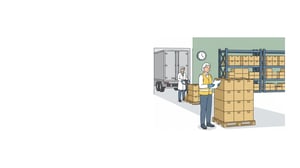
cGDP stands for current Good Distribution Practices: the conditions and practices that keep packaged food safe while it is received, stored, handled and shipped. Kiwa ASI publishes a cGDP audit standard, the cGDP Audit Program – Storage & Distribution, that turns those practices into a scored, certifiable audit for food warehouses, distribution centers, distributors and third-party logistics providers. It is HACCP-based and founded on FDA's 21 CFR Part 117, and sites that score 70% or higher earn a certificate. Here is what cGDP covers, how it differs from cGMP, and where it fits next to GFSI-recognized schemes.
cGDP at a Glance
Food safety certification grew up around manufacturing plants, but most food spends time in warehouses, trucks and distribution centers on its way to a shelf. cGDP applies the discipline of a manufacturing audit to that part of the supply chain: the sites that receive, store, pick and ship packaged food without processing it.[1]
- 3Modules in every cGDP audit: food safety management system, distribution practices and HACCPcGDP 2.0 standard
- 70%+Audit score that earns a certificate, rated Complies, Good or ExcellentcGDP 2.0 standard
- <2 hoursMock traceability and recall exercise completed during every audit, with the auditor presentcGDP 2.0 standard
- Jan 1, 2026Audits use version 2.0 of the standard, which replaced version 1.1 from 2018cGMP & cGDP 2.0 change summary
Key takeaways
- cGDP (current Good Distribution Practices) is a voluntary, third-party audit standard for food storage and distribution, published by Kiwa ASI. It is not a government regulation, but its criteria are founded on FDA's 21 CFR Part 117 and add industry best practices on top.[2][1]
- cGMP audits cover sites that make, process or pack food; cGDP covers the sites that store and move it. Warehouses, distribution centers, distributors, 3PLs, cross-docks and fulfillment centers are cGDP territory.[1]
- Every cGDP audit covers three modules plus a mock recall run in under two hours with the auditor present. Audits are annual, and a score of 70% or higher earns the certificate.[2]
- cGDP is not GFSI-recognized and not accredited. If your customers require GFSI-recognized certification, the storage and distribution options include, listed A to Z: BRCGS Storage and Distribution, FSSC 22000, IFS Logistics and SQF Storage and Distribution.[2][3]
Sources checked as of October 27, 2026, against the cGDP Storage & Distribution 2.0 standard, FDA regulations and Kiwa ASI's program pages.
What Does cGDP Stand For?
Current Good Distribution Practices are to a warehouse what current Good Manufacturing Practices are to a food plant: the baseline conditions and controls that keep products safe, in this case while food is received, stored, handled and shipped. The practices cover the building and grounds, sanitation, pest control, temperature and humidity, segregation and allergen handling, trailer condition, traceability and the people doing the work. The "current" means the bar moves: practices are expected to keep up with today's hazards and technology, not the ones from when a program was written.[1]
In the U.S. food industry, cGDP certification in practice means an audit against Kiwa ASI's cGDP Audit Program – Storage & Distribution, a published standard founded on 21 CFR Part 117, FDA's rule on current good manufacturing practice and preventive controls for human food. The criteria go beyond the regulation by adding industry best practices, and the whole program is HACCP-based: every certified site maintains a hazard analysis for its own receiving-through-shipping steps.[2][1] The current version, cGDP 2.0, was published on October 1, 2025 and applies to audits from January 1, 2026. It replaced the version 1.1 program from 2018, reorganized the requirements into three modules, restated them in measurable terms, and added or expanded requirements for management commitment and food safety culture, business licensing, certification integrity, electronic records, traceability exercises and a FSMA Food Safety Plan. Scoring did not change.[4][1]
In pharmaceuticals, GDP (Good Distribution Practice) is a different, regulated framework: the minimum standards wholesale distributors of medicines must meet so that quality and integrity are maintained through the supply chain, overseen in the EU by medicines authorities.[5] This article is about cGDP for food, a voluntary audit standard. If you distribute pharmaceuticals, you are under the medicines rules, not this program.
What Is the Difference Between cGMP and cGDP?
The difference is the operation, not the rigor. A cGMP (current Good Manufacturing Practices) audit is written for sites that make, process or pack food. cGDP takes the same foundation, 21 CFR Part 117, and aims it at sites whose work is storage and movement: nothing is cooked, mixed or filled, but product can still be contaminated, temperature-abused, infested, mislabeled or lost to poor traceability.[1][2]
Kiwa ASI publishes both as a family of audit standards, and version 2.0 of each took effect for audits on January 1, 2026.[4] Which one fits depends on what your site does:
| Program | Who it's for | What the audit emphasizes |
|---|---|---|
| cGMP Food Processing | Sites that manufacture or process food | Manufacturing and processing hazards, alongside the shared ground of sanitation, pest control and HACCP |
| cGMP Food Packaging | Makers of food packaging, direct-contact and non-contact | The same cGMP discipline aimed at packaging manufacturing |
| cGDP Storage & Distribution | Warehouses, distribution centers, distributors, 3PLs, cross-docks and fulfillment centers that store and ship packaged food without processing it | Storage conditions, receiving and shipping, trailer inspection, temperature monitoring and distribution traceability |
A site that both processes and warehouses food is audited as a processor; nearby satellite sites that extend a cGDP site's operations and share its management system can be added to its scope.[1]
If your facility only stores and ships sealed, packaged product, cGDP is the audit built for you. If you crack a single egg or fill a single jar, you are in cGMP territory, and FDA's preventive controls requirements apply more broadly too.[1]
Is cGDP Required by Law?
No. cGDP certification is voluntary: no law requires it, and holding the certificate does not replace FDA or USDA compliance. The pressure usually comes from customers instead. Retailers, brand owners and manufacturers ask their warehouse and distribution partners for a third-party food safety audit, and cGDP gives those sites one designed for storage and distribution rather than manufacturing.[1]
Voluntary does not mean warehouses are unregulated. These federal rules apply to food storage and distribution whether or not a site ever gets audited:
| Rule | What it requires |
|---|---|
| Food facility registration (21 CFR Part 1, Subpart H) | Holding food for U.S. consumption generally makes a warehouse a registered food facility. Registrations renew between October 1 and December 31 of every even-numbered year, so the current renewal window closes December 31, 2026.[6] |
| Current GMPs (21 CFR § 117.93) | Storage and transportation of food must protect against allergen cross-contact, against biological, chemical and physical contamination, and against deterioration of the food and its container.[7] |
| Sanitary Transportation rule (21 CFR Part 1, Subpart O) | Covered shippers, loaders, carriers and receivers divide the duties for vehicles, equipment, loading and temperature control; shippers set written operating temperatures for food that needs them.[8] |
| FSMA 204 Food Traceability Rule (21 CFR Part 1, Subpart S) | Warehouses that hold foods on FDA's Food Traceability List keep key data elements for receiving and shipping. The FDA will not enforce the rule before July 20, 2028, but it urges firms to start now and work with their supply-chain partners.[9] |
A cGDP audit is founded on 21 CFR Part 117 and checks registrations and licenses under its licensing element, so preparing for it largely means demonstrating the compliance your site already owes, plus the best practices customers expect on top.[2][1]
What Does a cGDP Audit Cover?
Every cGDP audit covers three modules, and all requirements are mandatory: one that does not fit your operation is recorded as not applicable, and exemptions need Kiwa ASI's written approval before the audit.[2][1]
- Module 1: Food Safety Management System (1.1–1.6). Management commitment and food safety culture, complaint management with root cause analysis, document control and record-keeping (including electronic records), training, business licensing, and certification integrity.[2]
- Module 2: Current Good Distribution Practices (2.1–2.15). The largest module: storage and distribution controls such as segregation, allergen handling and environmental monitoring; foreign matter controls; non-conforming goods, hold and release, traceability and recall; food defense; internal audits; vendor approval; hygiene; cleaning and sanitation; chemical controls; pest control; water and air quality; waste; receiving, storage and shipping; facility and equipment design; and maintenance and calibration.[2]
- Module 3: HACCP (3.1–3.13). A HACCP plan for your own receiving-through-shipping steps: a HACCP team whose leader and backup hold HACCP certificates from an IHA-approved course, product descriptions, a flow diagram, hazard analysis, CCPs and preventive controls, critical limits, monitoring, corrective actions, validation and verification, plus a Food Safety Plan overseen by a PCQI where FDA's preventive controls rule applies.[2]
On top of the modules, every audit includes a live mock traceability and recall exercise: trace one product one step back and one step forward, accounting for 100% of the product, in under two hours with the auditor present. It is run in addition to your own annual mock recall, not instead of it.[2]
A certification audit takes at least one day on site and recurs every year, and your site must be operating on the audit day. You also need at least 60 days of receiving and shipping records before the audit; without them, Kiwa ASI may stop it. The cGDP certification page walks through the full audit criteria, element by element.[1][2]
How Is a cGDP Audit Scored?
Every audit starts at 100%, and findings deduct points: 1% for a minor nonconformity, 5% for a major, and 100% for a critical, so a single critical finding (a clear deficiency that could cause serious illness or death, or falsified food safety records) is an automatic fail.[2]
| Rating | Score | Result |
|---|---|---|
| Excellent | 90–100% | Certificate issued; two Excellent audits in a row earn a Superior rating |
| Good | 80–89% | Certificate issued |
| Complies | 70–79% | Certificate issued |
| Fails | 0–69% | No certificate |
Some customers require a higher score than 70%. Requirements that don't apply are recorded as N/A with a justification.[1]
Findings shared at the closing meeting are drafts until Kiwa ASI's independent technical review, which can revise findings or the score before the certificate is issued. Corrective actions are not required to receive a certificate, though Kiwa ASI strongly recommends root cause analysis, and auditors can upgrade repeat nonconformities, for example from minor to major, at the next audit.[2]
Certification runs on an annual cycle: audits are conducted every year, and a site's certificate expires 30 days after the one-year anniversary of its last certification audit.[2]
Is cGDP GFSI-Recognized?
No. cGDP is Kiwa ASI's own audit standard. The standard itself says it is not accredited, and points sites that need an accredited standard to alternatives; cGDP is also absent from GFSI's list of recognized certification programs.[2][3]
That matters because some customers, especially large retailers, require GFSI-recognized certification rather than any third-party audit. The GFSI-recognized programs with storage and distribution scope include, listed A to Z: BRCGS Storage and Distribution, FSSC 22000, IFS Logistics and SQF Food Safety Code: Storage and Distribution. Kiwa ASI offers BRCGS Storage and Distribution audits and SQF Storage and Distribution certification, so a site whose customers later require a GFSI scheme can stay with the same auditing company.[3][1]
cGDP is a separate Kiwa ASI standard: SQF and the other GFSI-recognized schemes run their own full audit and certification process, from registration to certificate. What does carry over is the system, because the programs, records and HACCP plan a cGDP audit exercises are the same raw material a GFSI scheme audit builds on.[2]
So when is cGDP the right fit? When your customers accept a third-party food safety audit without mandating a GFSI scheme, cGDP gives a warehouse a published, scored standard to manage to, audited annually and built for storage and distribution rather than manufacturing. Our post on SQF Edition 10's storage and distribution changes shows what the GFSI-recognized path looks like when customers require more.[1]
Who Uses cGDP Certification?
cGDP certification is built for sites that receive, store and ship packaged food or food contact products without processing them. Certification is site-specific: each warehouse or terminal is certified at its own address.[1]
- Food warehouses and distribution centers, ambient, refrigerated and frozen
- Third-party logistics (3PL) providers running public and contract warehouses
- Food distributors and wholesalers, broadline, specialty and foodservice
- Cold storage facilities, where temperature monitoring and corrective actions are critical
- Cross-docks and freight terminals that unload, hold and reload food at a fixed site
- Fulfillment centers picking and shipping mixed-SKU orders of packaged food
Distributors of food packaging and other food contact products are in scope too. Sites that manufacture or process food belong in the cGMP Food Processing audit instead, and packaging makers in cGMP Food Packaging.[1]
How Do You Get cGDP Certified?
The path is short to describe; how long preparation takes depends on where your programs stand today. The standard is public, so you can read every requirement before spending anything.[1]
- 01Read the cGDP 2.0 standardDownload the cGDP Storage & Distribution 2.0 standard (PDF) and compare all three modules against what your site does today.
- 02Build your programs and HACCP planDocument the programs the auditor reviews, from allergen control, traceability and recall to sanitation, pest control and food defense, plus a HACCP plan covering receipt through distribution.
- 03Train your teamTrain all staff, including temporary workers, on cGDP, HACCP, food defense, allergens and illness reporting, and certify your HACCP team leader and backup through an IHA-approved course.
- 04Keep 60 days of recordsHave at least 60 days of receiving and shipping records before the certification audit.
- 05Book the certification auditThe audit is quoted per site and takes at least one day on site; findings pass Kiwa ASI's technical review before the certificate is issued, and an audit every year keeps it current.
The cGDP certification page covers the full ten-step path, audit-day schedule, criteria tables and cost lines, and an optional unscored mock audit is available if you want a practice run first (it can't be converted into a scored certification audit once it starts).[1]
Frequently Asked Questions
What does cGDP stand for?
cGDP stands for current Good Distribution Practices: the conditions and practices that keep packaged food safe while it is received, stored, handled and shipped. In food distribution it usually refers to Kiwa ASI's cGDP Audit Program – Storage & Distribution, a HACCP-based audit standard founded on FDA's 21 CFR Part 117.
Is cGDP the same as GDP in pharmaceuticals?
No. Pharmaceutical GDP is a regulated framework for wholesale distributors of medicines, overseen in the EU by medicines authorities. cGDP for food is a voluntary third-party audit standard for warehouses and distributors of packaged food.
Is cGDP certification required by law?
No. cGDP certification is voluntary and does not replace FDA or USDA compliance. Food warehouses still have regulatory obligations, including food facility registration, 21 CFR § 117.93 on warehousing and distribution, the Sanitary Transportation rule and, for listed foods, the FSMA 204 traceability rule. Customers, not regulators, are usually the reason sites certify.
What is the difference between cGMP and cGDP?
cGMP (current Good Manufacturing Practices) audits apply to sites that make, process or pack food. cGDP applies the same food safety discipline to sites that store and move packaged food: warehouses, distribution centers, distributors, 3PLs, cross-docks and fulfillment centers. Both cGMP and cGDP are founded on 21 CFR Part 117.
Is cGDP GFSI-recognized or accredited?
No. cGDP is Kiwa ASI's own audit standard; it is not accredited and is not GFSI-recognized. If a customer requires GFSI-recognized certification, storage and distribution options include, listed A to Z: BRCGS Storage and Distribution, FSSC 22000, IFS Logistics and SQF Storage and Distribution.
What score do you need to pass a cGDP audit?
70% or higher. Audits start at 100%, with 1% deducted per minor nonconformity, 5% per major and 100% per critical. Scores of 90–100% rate Excellent, 80–89% Good and 70–79% Complies; below 70% no certificate is issued. Two Excellent audits in a row earn a Superior rating.
How long does cGDP certification last?
One year at a time. cGDP audits are conducted annually, and a site's certificate expires 30 days after the one-year anniversary of its last certification audit.
What records do you need before a cGDP audit?
At least 60 days of receiving and shipping records. Without them, Kiwa ASI may stop the audit. The site also needs to be operating on the audit day.
Does a cGDP audit include a mock recall?
Yes. Every cGDP audit includes a mock traceability and recall exercise, tracing one product one step back and one step forward and accounting for 100% of the product in under two hours, with the auditor present. It is in addition to the annual mock recall your own program requires.
Does a cGDP audit count toward SQF certification?
No. cGDP is a separate Kiwa ASI standard, and SQF and the other GFSI-recognized schemes run their own full audit and certification process. The programs and records built for cGDP are the same material a GFSI scheme audit builds on.
Ready to put a certificate behind your warehouse?
Talk to Kiwa ASI about cGDP Storage & Distribution certification for your warehouse, distribution center or 3PL site, or about BRCGS and SQF storage and distribution options if your customers require a GFSI-recognized scheme.
Training is offered through ASI Training and Consulting, LLC, which operates separately from the certification body and has no effect on audit outcomes. Questions? Email US.Info@kiwa-asi.com or call 1 (800) 477-0778.
Keep reading
- PagecGDP CertificationThe full program: criteria, scoring, cost and the ten-step path.
- PagecGMP Food ProcessingThe manufacturing counterpart to cGDP.
- BlogSQF Edition 10: Storage & DistributionWhat changes for warehouses and DCs under Edition 10.
- PageSQF CertificationGFSI-recognized certification, including Storage and Distribution.
- BlogHow to Prepare for an SQF AuditA preparation plan that works for any scheme.
- PageFSMA 204 TrainingThe Food Traceability Rule's key data elements, explained.
Sources
- Kiwa ASI. cGDP Certification: Food Storage & Distribution Audits (accessed October 27, 2026). asifood.com
- Kiwa ASI. ASI cGDP Audit Program – Storage & Distribution 2.0 (PDF; audits from January 1, 2026). asifood.com (PDF)
- GFSI. GFSI-Recognised Certification Programme Owners, including scope G, Provision of Storage and Distribution Services (accessed October 27, 2026). mygfsi.com
- Kiwa ASI. cGMP & cGDP 2.0 Structure and Change Summary (PDF, October 1, 2025). asifood.com (PDF)
- European Medicines Agency. Good distribution practice (accessed October 27, 2026). ema.europa.eu
- U.S. FDA. 21 CFR Part 1, Subpart H, Registration of Food Facilities (§§ 1.225–1.230). ecfr.gov
- U.S. FDA. 21 CFR § 117.93, Warehousing and distribution. ecfr.gov
- U.S. FDA. 21 CFR Part 1, Subpart O, Sanitary Transportation of Human and Animal Food (§§ 1.900–1.934). ecfr.gov
- U.S. FDA. FSMA Final Rule on Requirements for Additional Traceability Records for Certain Foods (compliance date). fda.gov